

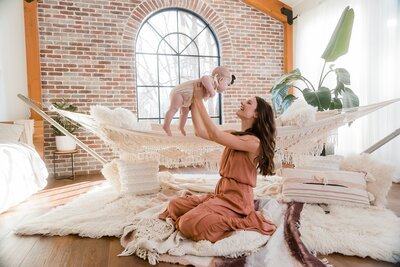


A finished portrait deserves more than a camera roll and a someday plan. This family artwork design guide is for parents who want the images from their session to become part of the rooms where real life happens: the entryway crossed with backpacks, the nursery during late-night feeds, and the living room where everyone gathers at the end of the day.
Choosing artwork can feel surprisingly personal. You are not simply selecting a frame or deciding between color and black and white. You are deciding what you want to see when you pass through your home years from now. With a thoughtful approach, the process can feel calm, clear, and genuinely enjoyable.
Start with the feeling, not the frame
Before measuring walls or comparing finishes, consider the feeling you want your home to hold. Some families are drawn to a single, sweeping portrait that lets an emotional connection take center stage. Others want a collection that tells a fuller story: pregnancy, newborn days, a first birthday, or the changing expressions of a growing child.
There is no universally correct answer. A large portrait can create a beautiful focal point in a room with clean lines and open wall space. An album may be the better choice for families who love variety, have limited wall space, or want an intimate way to revisit an entire session. Often, the most satisfying plan includes both: one statement piece for daily enjoyment and an album for the images that deserve to be held.
Think about how you want the artwork to meet you. Do you want a quiet, tender image in your bedroom? A joyful family portrait that welcomes guests? A collection in the hallway that becomes richer as your family grows? Starting there helps every later decision make sense.
Choose the right home for each portrait
Artwork feels most natural when it is designed for the room rather than squeezed into the first blank wall available. Walk through your home slowly and notice the places your eyes naturally land. An entryway, stairwell, dining space, primary bedroom, nursery, and living room all offer different possibilities.
A family portrait often belongs in a shared space, where everyone can enjoy it. A newborn portrait can be especially lovely in a nursery or bedroom, where its softness suits the room’s quieter purpose. Milestone imagery works beautifully in a hallway, where a sequence of frames can mark change without making the space feel overly formal.
Lighting matters, too. Avoid placing artwork in direct, intense sunlight whenever possible. Even professionally produced archival pieces are best protected from prolonged exposure. Consider what the room looks like in the morning, at night, and during the seasons when the light shifts. Artwork should be easy to see and comfortable to live with, not lost in glare.
Scale is what makes artwork look intentional
The most common design mistake is choosing artwork that is too small for the wall. A beautiful portrait can lose its presence when it floats above a sofa or console table with too much empty space around it. When in doubt, larger is usually more balanced than smaller.
For artwork above furniture, a helpful starting point is to choose a piece or arrangement that spans roughly two-thirds to three-quarters of the furniture’s width. A 60-inch sofa, for example, often needs artwork or a gallery arrangement around 40 to 45 inches wide. This is not a rigid rule, but it gives the eye a sense of proportion.
Hang the center of a single piece near eye level, typically around 57 to 60 inches from the floor. Above a console, crib, or sofa, leave enough breathing room so the artwork feels connected to the furniture without appearing crowded. If you are uncertain, use painter’s tape or paper templates to mark the dimensions on the wall before ordering. It is a simple step that can prevent a costly guess.
When a gallery wall is the better choice
A gallery wall is not merely a way to display more photos. It can create rhythm, movement, and a sense of history. It works especially well on staircases, long hallways, and walls where one oversized piece would feel too heavy.
The key is consistency. Choose a shared element, such as matching frames, a restrained color palette, or a common mat style, so the collection feels considered. The images do not need to be identical in pose or expression. In fact, a mix of close details, affectionate moments, and wider family portraits often makes the arrangement more engaging.
Keep the gaps between frames consistent, usually two to three inches, and plan the entire arrangement before putting the first nail in the wall. A professional design consultation is valuable here because spacing, scale, and image selection all work together.
Let your home’s style guide the finish
Your portraits should feel like they belong in your home, not like they were added as an afterthought. Look at the finishes already present in your space: warm wood, black metal, soft linen, painted cabinetry, or light oak floors. These details can inform frame color, matting, and whether your artwork should feel crisp and contemporary or softer and more traditional.
A light wood or natural frame can bring warmth to an airy, organic room. Black frames offer definition and work well in modern interiors or spaces with darker accents. White frames can feel fresh and gentle, particularly in a nursery, though they need enough contrast against the wall to remain visible. If your home includes several wood tones, do not feel obligated to match every one. Coordinating is more elegant than exact matching.
Color portraits and black-and-white portraits each have a role. Color holds the warmth of skin tones, wardrobe, and the environment created during your session. Black and white can remove distraction and emphasize expression, touch, and connection. For a home with a lot of pattern or color, black and white may create a calmer result. In a neutral room, a color portrait can add life without overwhelming the space.
Invest in materials meant to be lived with
There is a meaningful difference between a quick print and professionally crafted artwork. Your family photographs will be handled, moved, dusted, and seen every day. They should be produced with materials designed for lasting color, durable construction, and a finish that does justice to the image.
Framed archival prints are a classic choice because they are versatile and easy to integrate into nearly any room. Canvas offers a softer, more painterly presence and can work well for larger statement pieces. Mounted prints may suit clean, modern spaces. Albums offer their own kind of permanence: a tactile record of a season that can be opened with your children, not simply stored away.
The right product depends on your home and habits. If you move frequently or like to refresh your walls, framed pieces offer flexibility. If you want a single, substantial installation, a large finished wall portrait may be more satisfying. If your favorite images are too numerous to narrow down, an album keeps the story together without asking every photograph to compete for wall space.
Design for the family you are becoming
Many parents hesitate because they know life will change. The nursery will become a big-kid room. Another baby may join the family. Furniture may be rearranged. That does not mean you should wait to display the photographs you love.
Choose artwork that honors this chapter without trying to predict every future chapter. A maternity portrait, newborn image, or family session does not become less meaningful as your family changes. It becomes part of the visual record of how you got here.
If you are building a gallery over time, leave room for growth. Begin with a few well-sized pieces rather than filling every inch at once. Consistent frames and thoughtful spacing make it easy to add future portraits while preserving the original design.
A family artwork design guide works best with support
The best artwork decisions rarely happen while scrolling alone late at night, trying to imagine dimensions on a blank wall. Seeing sample materials, comparing sizes, and receiving guidance from someone who understands portrait design can replace uncertainty with confidence.
At Glean & Co, the ordering process is designed to make those decisions feel cared for. We consider your images, your rooms, and the way you want your home to feel, then help you select artwork that will remain beautiful long after the session itself. You do not need to arrive with a design plan. You only need to know that these images matter to you.
Start with one wall, one room, or one album. The most meaningful homes are not styled all at once. They are built gradually, with reminders of the people who make them feel like home.


LEAVE A COMMENT
Comments